
In late April this year I had the privilege of visiting the first Mercy house at Baggot Street in Dublin. Many of you reading this will have been and will immediately be transported back to your own response to walking through those red doors for the first time. For those who haven’t been, I hope this short reflection will give some insight into my own experience and perhaps prompt your own pilgrimage at some point in the future.
I was fortunate to join a group put together by our counterparts in Australia, Mercy Companions. While being mistaken for an Australian became a constant challenge (!) it was a joy and highlight of the trip to share time with a group of people who are contributing to, and so passionate about, the work being done by Mercy organisations across Australia and New Zealand.
For me, being at Baggot Street underscored Catherine’s huge appetite for risk – something our current highly regulated corporate environments (even in the not-for-profit space) are less than conducive to. One cannot help but be impressed by the scale of the house at Baggot Street. From the colonnades to the striking double sized red doors, the property remains as impressive today as it must have been nearly 200 years ago. What struck me as even more impressive though was that this large-scale build was completed by a Catholic woman in pre-emancipation Ireland. From the excellent historical scene setting sessions we received it was clear that a Catholic man would have had a very difficult time getting a property of this nature built during that period. That Catherine achieved it as a woman is truly remarkable. Having worked in the development sector for many years in New Zealand I am acutely aware that there are still very, very few woman developers – and yet that’s what Catherine was at that point – a property developer, directing every last detail of a very significant and very expensive build.
Sometimes in business or governance we talk about Big Hairy Audacious Goals. The things that challenge us to change the status quo, put a stick in the spokes and upset the ordinary. I very much doubt Catherine had ever heard of a BHAG. But that’s what she had and that’s what she accomplished – a big hairy and very audacious development project which would place the poor and vulnerable right in view of the rich and the privileged. It was an undeniable challenge to the status quo, a stick in the spokes of a Dublin establishment that might assist the poor but did not necessarily want to have to see them. I was reminded that Catherine wanted that changed. She wanted the rich to see the poor and vice versa. She wanted the divide to be reduced – and isn’t that as much of a challenge today as it was then? Perhaps more so. It is always tempting to look away from the poor and the vulnerable. To want things to be solved out of sight and preferably by other people. That was not Catherine’s approach. That is not our charism as Mercy leaders and supporters.
This was further reinforced to me by a most excellent presentation from Sister Sheila Curran, on our penultimate day in Dublin. Sister Sheila has a PhD in theology and has spent many years working among the poor in Peru. Her challenge rang boldly through the former school room in Baggot Street where our group was assembled – “we can keep helping the poor or we can work to change the structures that keep people poor”. Having spent some days in the quiet reflective environment of Catherine’s legacy, Sister Sheila’s words felt challenging and proactive, perhaps even subversive. Certainly, they seemed to touch some nerves in the room and created quite some heated discussion when we broke. And yet wasn’t this exactly what we might have expected Catherine to say some 200 years prior when she too was challenging the status quo? Didn’t she challenge the system that kept people poor by building a grand house in a rich suburb and using it to educate poor young woman and provide them with the means to earn a living, lifting them out of poverty and changing intergenerational outcomes. Wasn’t she exactly the stick in the spokes that the poor and vulnerable in Dublin needed at that time?
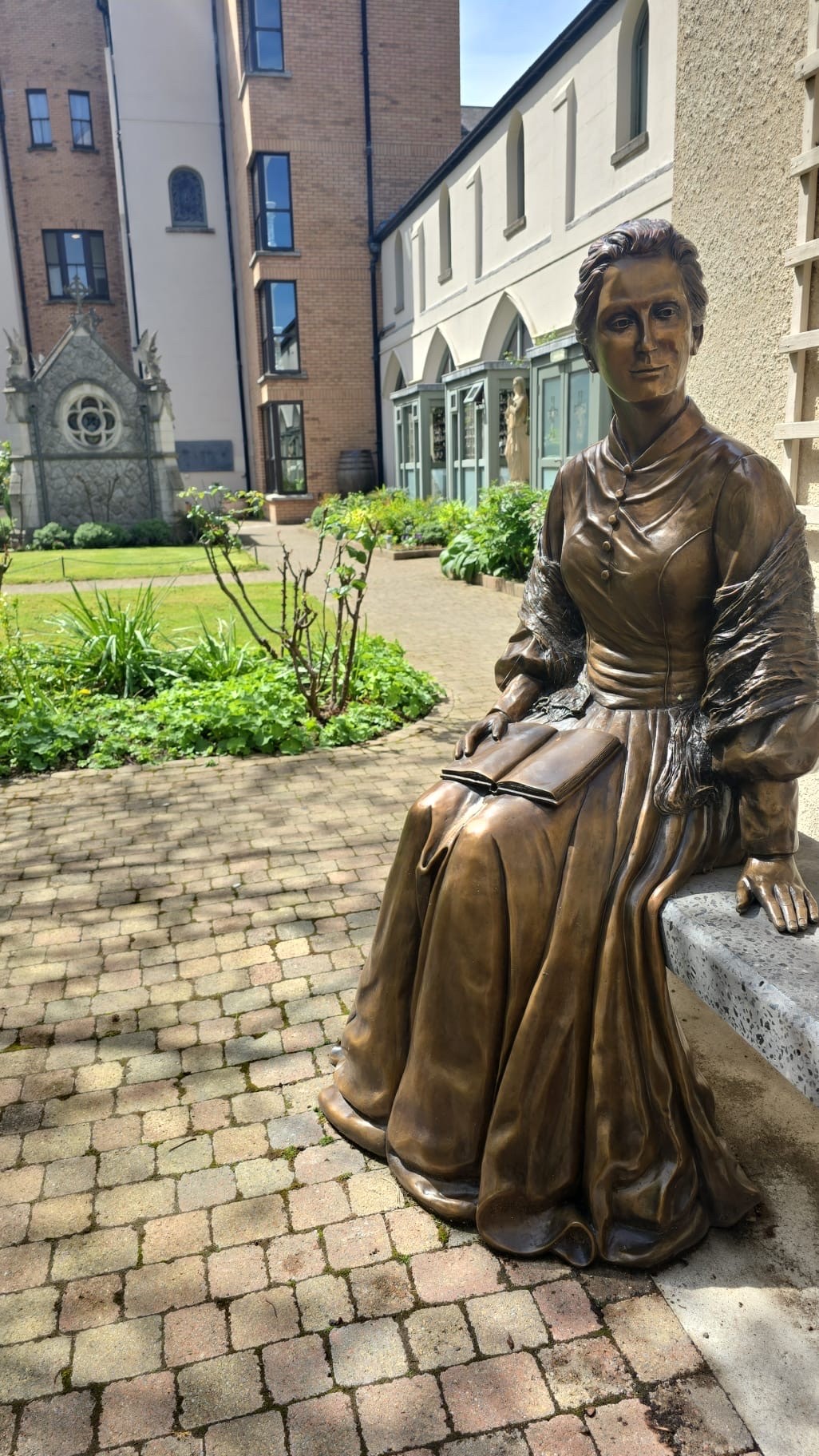
There is a beautiful bronze sculpture of Catherine in the garden at Baggot Street. I sat with her after that challenging session on the Friday. I was needled by some of the responses to the challenge laid down, concerned that perhaps inadvertently we were the rich and privileged endeavouring to maintain the structures that serve us so well and disenfranchise others. I felt I needed a quiet moment with Catherine in the garden to reflect. But what I found was not quiet contemplation. As I sat next to Catherine I realised I was right to be angry. I think Catherine herself would be angry at the continued gap between rich and poor and the deprivation that so many experience. I think she would encourage us to challenge the status quo, to think outside our traditional boxes and throw a stick in the spokes of established structures and institutions. I think she would tell us to never be complacent. I think she would tell us to be brave and bold and fierce in pursuit of our mission. I think she would tell us to never give up.
The Catherine I met at Baggot Street was rebellious, provocative, subversive, a strong smart woman with a Big Hairy Audacious Goal. I am not sure that this is the Catherine that is always captured in what has been written about her. But I choose to believe that’s who she was and I am so grateful to have had the chance to meet her.
Thank you to WMMT and Mercy Hospital and all of the sisters who hosted and spoke with us for giving me that opportunity.
By Lauren Semple